Why Is My Boiler Losing Pressure? Causes and Solutions
If your boiler keeps losing pressure and dropping to zero, it's a frustrating and fairly common problem. A boiler that won't hold pressure can leave you without heating and hot water — and it almost always points to a leak somewhere in your central heating system. In this guide, our heating engineers explain why your boiler is losing pressure, how to repressurise it safely, and when to call a professional.
What Should My Boiler Pressure Be?
A healthy boiler pressure sits between 1 and 1.5 bar when the system is cold. When the heating is on, it can rise to around 2 bar — that's normal. If the pressure drops below 1 bar, your boiler may shut down to protect itself. If it rises above 3 bar, the pressure relief valve will release water to prevent damage.
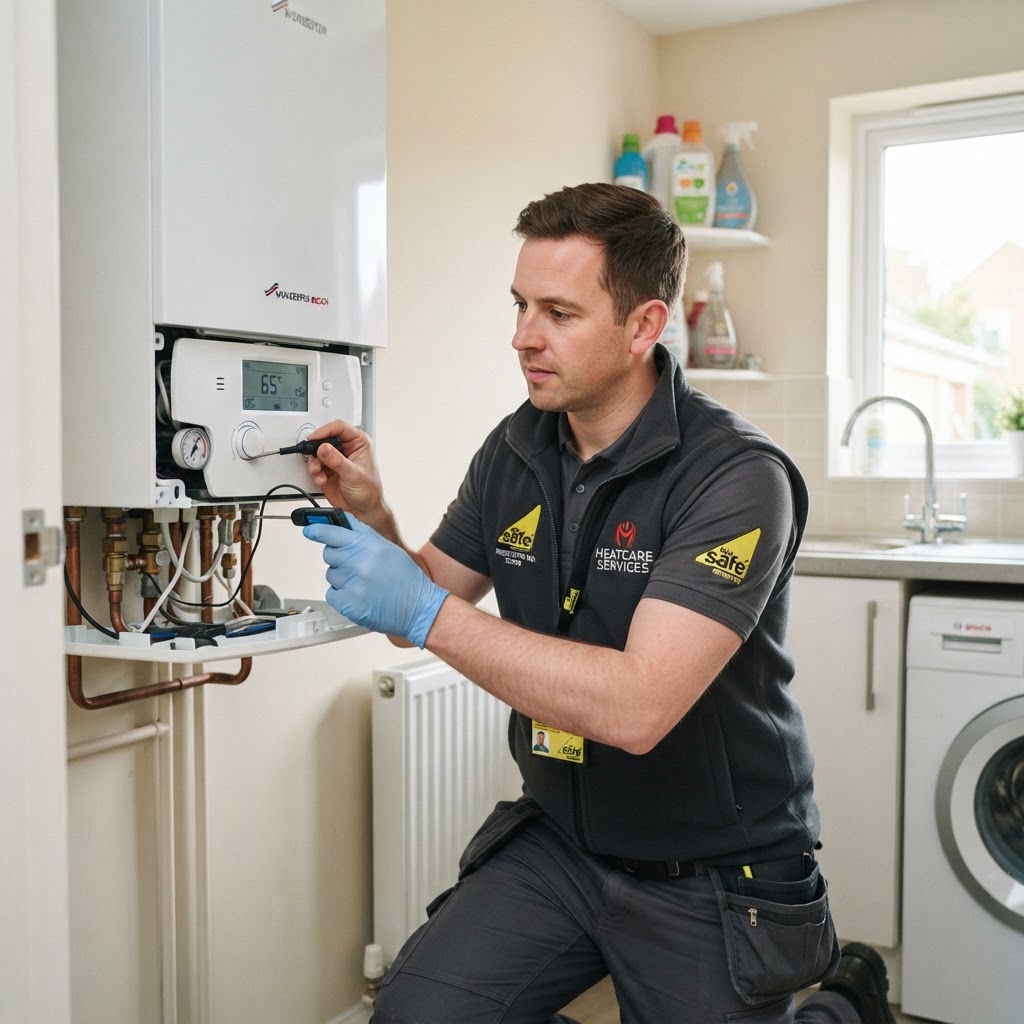
Check the pressure gauge on the front of your boiler (or the digital display on newer models).
Why Is My Boiler Losing Pressure?
There are two main reasons your boiler pressure keeps dropping:
1. A Leak in the System (Most Common)
Pressure loss almost always means water is escaping somewhere. The leak might be tiny — just a slow drip — but over a day it's enough to drop the pressure. Common leak locations include:
- Radiator valves — a slow weep from the gland nut.
- Pipe joints — micro-leaks at soldered or compression joints, often under floors.
- The pressure relief valve (PRV) — a faulty valve letting water escape out of the condensate pipe.
- The heat exchanger — a cracked or corroded heat exchanger leaking internally.
- Radiator bodies — pinhole corrosion causing slow leaks.
2. A Faulty Pressure Relief Valve (PRV)
The PRV is a safety valve that releases water if the pressure gets too high. If it's faulty or has been triggered, it can let water escape continuously, dropping the pressure. You might see water dripping from the copper pipe outside your home.
3. Recently Bled Radiators
If you've just bled your radiators, you've released water and air, which lowers the system pressure. Simply repressurise the boiler afterwards.
4. A Faulty Expansion Vessel
The expansion vessel absorbs the pressure changes as water heats and cools. If it loses its charge, pressure will spike when hot and drop to near zero when cold. This needs recharging or replacing by an engineer.
How to Repressurise Your Boiler
If your pressure has dropped to zero, you can usually repressurise it yourself using the filling loop — a flexible braided hose connecting two valves under the boiler.
- Turn off the boiler and let it cool.
- Find the filling loop — a silver braided hose with a valve at each end.
- Open both valves slowly — you'll hear water flowing in.
- Watch the pressure gauge — stop when it reaches 1.2–1.5 bar.
- Close both valves and check the gauge holds steady.
- Reset the boiler and turn it back on.
If the pressure holds after this, you may have just needed a top-up. If it drops again within a day or two, you have a leak that needs finding.
How to Find a Leak in Your Heating System
Check the Obvious Spots First
- Look under all radiators for damp patches or staining.
- Check radiator valves — wipe them with a dry cloth and see if moisture returns.
- Look at the copper blow-off pipe outside — is it dripping? That points to a faulty PRV.
- Check under the boiler for drips or corrosion marks.
- Inspect visible pipework in cupboards and behind the boiler.
Hidden Leaks
If you can't see a leak, it may be under the floor or within a wall. This is where you need a professional. Our engineers use thermal imaging and pressure testing to locate hidden leaks with minimal disruption.
When to Call a Heating Engineer
Call a Gas Safe registered engineer if:
- The pressure keeps dropping after repressurising.
- You can see water leaking from the boiler, valves or pipes.
- The pressure relief pipe outside is dripping.
- The boiler fires up but shuts down with a low-pressure fault code.
- The pressure spikes over 3 bar when heating.
Can I Keep Using My Boiler with Low Pressure?
Not recommended. A boiler running with low pressure can:
- Overheat and damage the heat exchanger.
- Trigger repeated lockouts, wearing out components.
- Run inefficiently, costing you more in gas.
- Eventually fail completely, leaving you without heat or hot water.
If the pressure drops, repressurise once and see if it holds. If it drops again, book an engineer rather than repeatedly topping it up — every top-up adds fresh water and oxygen, which speeds up corrosion inside your radiators.
Preventing Boiler Pressure Problems
- Get an annual boiler service — engineers check the pressure relief valve, expansion vessel and connections.
- Fix leaks early — a tiny drip becomes a big problem.
- Don't over-repressurise — above 2 bar cold is too high.
- Bleed radiators then repressurise to keep the system balanced.
- Book a powerflush if your system is old and sludged up — sludge causes corrosion and pinhole leaks.
Get Your Boiler Pressure Fixed in Dartford & Kent
If your boiler keeps losing pressure, don't ignore it — it rarely fixes itself. Our Gas Safe registered engineers at Warren Plumbing & Heating find and fix pressure loss every day across Dartford, Bexley, Gravesend, Swanley and Kent.
Call 07793 134077 or book a repair online — we'll find the leak, fix the fault and get your pressure holding steady again.